World Population Officially Reaches Eight Billion People

- U-Report


VIVA – According to projections by the United Nations (UN) Population Division, the world's eighth billionth resident has been born. Therefore, the world population reaches eight billion. However, although there are more people on Earth, population growth is at its slowest rate in more than 70 years.

As quoted from Nature, the latest UN population update released in July this year also revises its long-term projection down from 11 billion people to 10.4 billion by 2100.
Then, by 2020, the world population growth rate fell below 1%. This is largely due to a decline in birth rates with women having fewer children due to widespread contraception and better education and mobility for women.

The UN Secretary-General, Antonio Guterres, said the statement regarding the world's population has reached eight billion.
"It is an opportunity to celebrate our diversity, recognize our common humanity, and a miracle at the advances in health that have extended life spans and dramatically reduced maternal and child mortality." Antonio Guterres remarked.

"At the same time, it is a reminder of our shared responsibility to care for our planet and a moment to reflect on where we still fall short of our commitments to each other." He added.
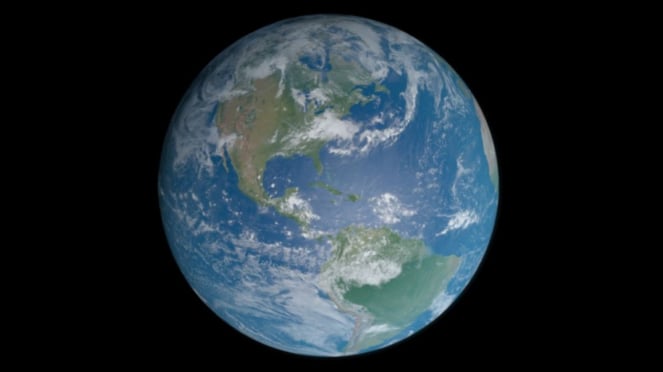
Ilustrasi bumi
- Pixabay/Steven Goddard
It is known that the two fastest-growing regions in the world are East and Southeast Asia, home to 2.3 billion people, and Central and South Asia, which has 2.1 billion people. China and India are the most populous countries in the world, with 1.4 billion people each. According to UN projections, India will surpass China for the first time next year.
More than half of the projected increase through 2050 will be concentrated in eight countries: the Democratic Republic of Congo, Egypt, Ethiopia, India, Nigeria, Pakistan, Philippines, and Tanzania.
Countries in sub-Saharan Africa are expected to contribute more than half of the anticipated increase by 2050. The largest increases will come in particular from the Democratic Republic of Congo and Tanzania, with both populations doubling in the next 30 years.