Saturn's Rings Predicted to Disappear in the Future

- U-Report

VIVA – Of all the planets in the solar system, Saturn is the most beautiful because of its striking rings. The rings sparkle with different colors, including pink, gray, and brown. However, Saturn's rings are not permanent.

It is hard to imagine Saturn without rings, but researchers have confirmed that the rings are on their way out.
As reported from the NASA website, December 17, 2018, NASA researchers have observed Saturn's rings using the Voyager 1 & 2 spacecraft.

The results showed that Saturn's rings are pulled into Saturn by gravity as a dusty rain of icy particles under the influence of Saturn's magnetic field.
"We estimate that this 'ring rain' drains an amount of water product that could fill an Olympic-sized swimming pool from Saturn's rings in half an hour," said James O'Donoghue of NASA's Goddard Space Flight Center in Greenbelt, Maryland.

Saturn's rings lose material every year. Incoming micrometeorites and solar radiation disturb small pieces of dusty ring material.
The particles, suddenly transformed, become aligned with Saturn's magnetic field lines and begin to spin along those invisible paths.
When the particles get too close to the top of Saturn's atmosphere, gravity pulls them inward, and they evaporate in the planet's clouds. Astronomers call this ring rain.
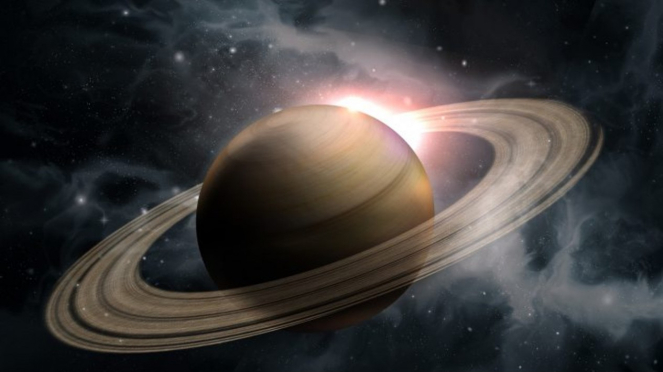
Cincin Planet Saturnus.
- Earth.com
According to James O'Donoghue, is the heyday of Saturn's rings because humans can see them in good conditions. O'Donoghue and other scientists estimate that the rings will disappear in about 300 million years.
The Origin of Saturn's Rings
Despite knowing they will disappear, astronomers still don't know everything about Saturn's rings, including their origin.
Various theories have been proposed for the origin of the rings. Saturn's rings have fascinated observers for centuries, but they were only really explored for the first time in the early 1980s.
Back then, NASA's Voyager spacecraft whizzed past them during a massive tour of the outer planets. At the time, scientists thought that the rings might have formed next to Saturn around 4.6 billion years ago, when the solar system was young and boisterous.