Bank Indonesia Releases 2022 New Edition Rupiah Banknotes

- Youtube Bank Indonesia



VIVA – Bank Indonesia and the Government releases seven new edition rupiah banknotes on Thursday, August 18, 2022. The 2022 Issue Year Rupiah Banknote (2022 ET Money) with nominal issued in denominations of Rp1,000, Rp2,000, Rp5,000, Rp10 .000, Rp20,000, Rp50,000, and Rp100,000.

The Governor of Bank Indonesia, Perry Warjiyo stated that the seven banknote denominations will become legal tender starting on August 18, 2022, thus complementing the existing banknotes.
"Today, August 18, 2022, I officially launch seven denominations of the 2022 Issue Year Rupiah Banknotes as legal tender throughout the territory of the Unitary State of the Republic of Indonesia (NKRI)," The Governor of Bank Indonesia, Perry Warjiyo said in Jakarta.

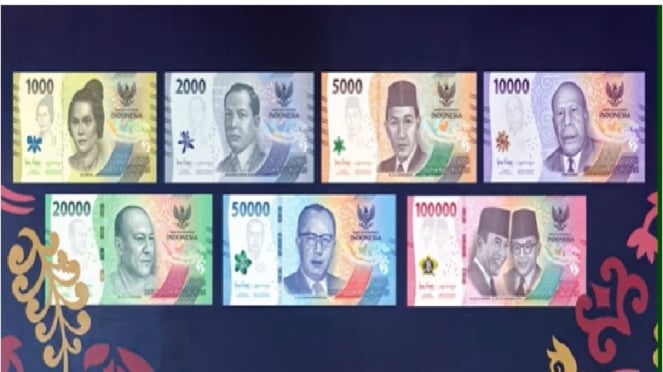
Uang Rupiah Kertas Emisi 2022
- Youtube Bank Indonesia
The new banknotes denominations still maintain the main image of national heroes on the front as well as Indonesian cultural themes such as dance, natural scenery, and flora on the back of 2016 TE Money.

However, there are three aspects of strengthening innovation in the 2022 TE Money. Such as a sharper color design, a more reliable security element and better resistance to currency materials.
This innovation is intended to make rupiah currency easy to recognize for authenticity, comfortable and safe to use and more difficult to counterfeit. So, it becomes more qualified and reliable.
The issuance of the 2022 TE Money, which coincided with the momentum of the 77th Republic of Indonesia's Independence Day, became a manifestation of the spirit of nationalism, and sovereignty to grow optimism for the recovery of the national economy.
“The release of rupiah is a concrete manifestation of our shared commitment to provide quality and reliable rupiah currency. As a symbol of state sovereignty and unifying the nation," Perry Warjiyo remarked.
Meanwhile, the circulation of the 2022 TE Money is one of the implementations of the mandate of the Currency Law as part of planning to meet the money needs of the public while still implementing governance according to the law.