List of Proven and Unproven Predictions by Albert Einstein

- U-Report




4. Black Hole

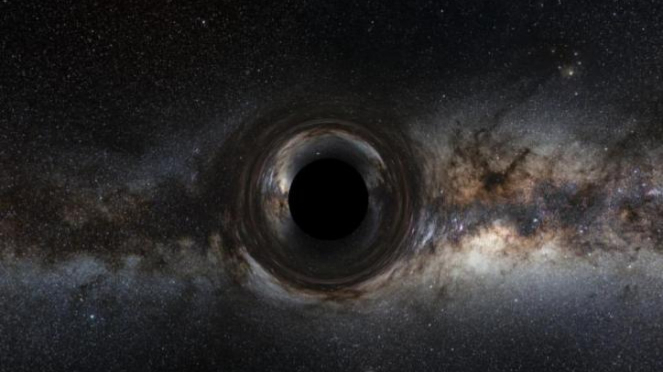
Black hole.
- U-Report
A black hole is a region of spacetime that exhibits such a strong gravitational acceleration that no particles or even electromagnetic radiation such as light can escape it. The general theory of relativity predicts that a sufficiently dense mass can deform spacetime into a black hole.

The boundary of the region from which it is impossible to escape is called the event horizon. Although the event horizon has an enormous effect on the fate and state of objects that pass through it, there seem to be no locally detectable features that can be observed. In many ways, a black hole acts like an ideal black body as it does not reflect light.
The Unproven Predictions:

White Hole

White hole, lubang putih yang melontarkan material di alam semesta
- dvice.com
Albert Einstein described white holes as "time reversals" of black holes. A black hole record played backward like a bouncing ball is a time reversal of a falling ball.
While the event horizon of a black hole is a ball of no return and the event horizon of a white hole is an unacceptable boundary where no spacecraft can reach the edge of the region. Objects inside a white hole can come out and interact with the outside world. But since nothing could enter, the interior is cut off from the universe's past. No outside events will affect its interior.
Although information and evidence regarding white holes remain inconclusive, GRB 060614 2006, has been proposed as the first documented observation of a white hole.
Wormhole

Ilustrasi lubang cacing
- www.pixabay.com/Genty
It is a speculative structure connecting different points in spacetime that is based on a special solution of Einstein's field equations. Wormholes can be visualized as tunnels with two ends at separate points in spacetime (ex: different locations, different points in time, or both).
Wormholes are consistent with the general theory of relativity, but it remains to be seen if they exist. It can connect vast distances such as a billion light years or more, and short distances such as a few meters, different universe, or different points in time.